Due to current circumstances, I’ll be cancelling/suspending my wordpress domain, deskofericsoller.com. Until I can afford to establish a more versatile website for my blog, portfolio, and more, my blog will continue via my Facebook page, so please visit me there. Thank you for your support.
Moving Op. H.A.U.N.T. Forward
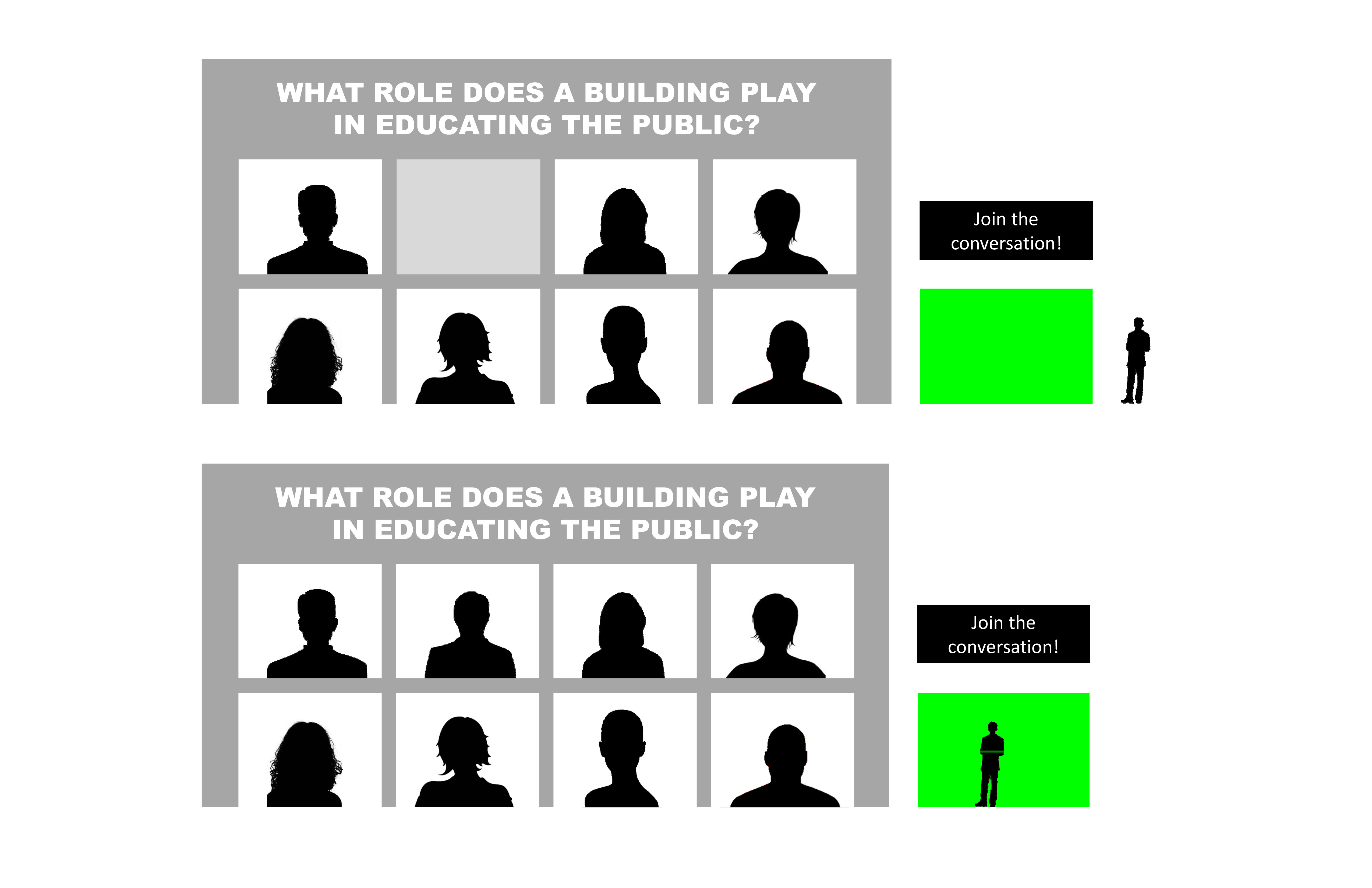 My Integrated Design 5 class has ended, but I intend to continue moving Operation H.A.U.N.T. forward with Allied Media in the hopes of making it a reality. After transcribing the interview with SmithGroupJJR, I summarized some of the major points and revised the questions to better suit the scope and purpose of my project. Here is the Q&A dialogue:
What essential roles does a building play in educating the public?
- Cropping mechanism – with infinite knowledge comes a need to narrow down and focus on pieces of information one at a time. The building is a controlled space which helps provide that sense of consistency within its walls.
- Landing Pad – the building provides a concrete location for people to routinely gather, seeing the same school every day, adding to that sense of consistency for a regimen.
- Backdrop – the building provides resources which define what kind of education takes place within the building, setting the stage for anything from listening to a 1-person lecture to student project collaborations.
How does the form of a building affect how people are educated?
- Large vs. Small – a small building offers a more controllable environment, which is useful for small communities or more specific training and education within a large community. A large building offers the potential to house enough students for interaction between a wider range of age groups and backgrounds helps prepare students for the diversity of the working world.
- Single Building vs. Campus – A single building school is usually structured to have all of the students learning the same thing and a little bit of everything. A campus will fragment the education, allowing each building design to be tailored to more specific areas of study.
- Accessibility – Education needs to be accessible, especially in Detroit, whether people travel to a building to learn or the education is brought to the student. The building can be small in size, but provide access to online and digital information from anywhere, increasing the building’s virtual accessibility, even if the physical form is unchanged.
How do abandoned areas weaken the educational roles that a building can provide?
- Loss of interaction – education cannot take place in a building without people to participate in teaching or learning.
- Loss of resources – without anyone to maintain some sort of organization or security, the building can lose some of its structure for education or even keeping the building itself safe and standing.
- Loss of value – the former owners, or as is usually the case in Detroit, the banks, no longer find value in the building, so the building is no longer used, and often left to rot.
How can abandoned areas benefit the educational roles that a building can provide?
- Drawing attention – vacancy is often highlighting. People don’t always realize that something was there until it’s gone or vacated. Think about how much attention Michigan Central Station gets.
- Historical curiosity – people naturally want to learn about a building’s history, particularly when it’s no longer taking place, like looking at the ruins of a Roman Temple. People are still learning from that.
- Invitation for opportunity – as soon as one organized structure moves out, the building becomes available as a resource, ready to be taken and used by a new occupant, like a hermit crab moving from one shell to another.
These questions will serve as an example of the kind of discussion Operation H.A.U.N.T. will be designed to initiate. While displaying the actual question on the building may be a little too straightforward, my next challenges will be to find a way to introduce the questions in a more open-ended and interpretive way, and also to make people feel more comfortable stepping forward and joining the discussion, as it may be disconcerting for some people to see their own faces blown up on the façade of a building.

I filmed my final class presentation last Wednesday, but I won’t be able to upload the video until I get back from my vacation in New Mexico on the 4th of August. So stay tuned. My YouTube channel is https://www.youtube.com/channel/UCIxZr0vCqpWJsI0q5bcygig
Interview with SmithGroupJJR
My first step for Operation H.A.U.N.T. is to film live interviews with the community. Thanks to my ID5 lab professor, Laura Roberts, I was able to conduct an interview with her colleagues at SmithGroupJJR, an architecture firm based in Detroit. Whether or not I use the interview in the projections, the content will inform this project and provide insight on both the architectural and digital needs for the educational community of Detroit. You can watch the original, uncut interview below.
Operation H.A.U.N.T.

Projectors display prospective futures of Detroit’s abandoned buildings
After a great amount of brainstorming, the nature of my project has changed to have a more specific focus. This is Operation H.A.U.N.T.:
Hosting
Apparitions for the
Urban
Need of
Transformation
The goal is to virtually occupy abandoned buildings within Detroit by projecting a modern schoolhouse environment with teachers, students, etc. over their broken facades. When one of the biggest attractions of Detroit is its abandoned buildings, this provides an opportunity for movement. People come in from all around the country to gaze into the Detroit’s thriving history, but Operation H.A.U.N.T. is going to change perspectives. Instead of gazing into the past, viewers will see a potential future for these ruins. Instead of focusing on the decline of Detroit, Operation H.A.U.N.T. will provide the community with a sense of hope and opportunity for the future of Detroit.
Midterm Review
Last Monday (June 15), our class had a midterm review to discuss our research and start the process in developing a tangible project. The critics wanted me to focus on the role of technology in Allied Media Projects; exploring the social implementations of technology as well as the spatial impacts of the work they produce. The Allied Media Conference 2015 was taking place the following weekend, so I needed to find connections between my own agenda and the goals of Allied Media.
The following workshop, which took place on Wednesday (June 17), the critics came back to work with the class individually. Mike Hopkins worked with me to discuss my goals as an architect, which are more environmental than social, and where my focus should be to connect with an organization who is all about social movements within Detroit. Most of the ideas were sketchy and vague, but we made a lot of progress brainstorming ideas from mapping out CO2 emissions within Detroit to raise awareness within the community to creating a digital rendering of the city projected on a screen acting as a window to Detroit’s future, showing what it might look like in the future.
On Saturday, I attended the Allied Media Conference. I only stayed for a short period of time, but I was able to speak with the program manager of the conference and network with a few other people. The session I stayed for was called Speculative Cities: Becoming Place. The presentation was about the role of gentrification throughout Detroit’s history and the need for communities to break out of isolation and connect with each other, helping to re-define the city of Detroit. The presentation helped me understand the importance of social connection, and I started to readjust my thinking towards my project.
Now, I am in the process of developing a way for people from different neighborhoods within Detroit to find each other, through technology. I recalled reading about a project, which has now become a significant case study in my research, where doors were installed in random places on the street in Europe, and people would open them to see a mime performance in Milan or have their portraits painted by a sketch artist in Brussels. It was all done with big screens and cameras. The concept was to get people to visit different areas of Europe because they’re “just next door.” This project has become a huge inspiration in my own project to connect different neighborhoods within Detroit.
Here’s a link to an article and video about the European project.
Detroit Digital Justice Coalition
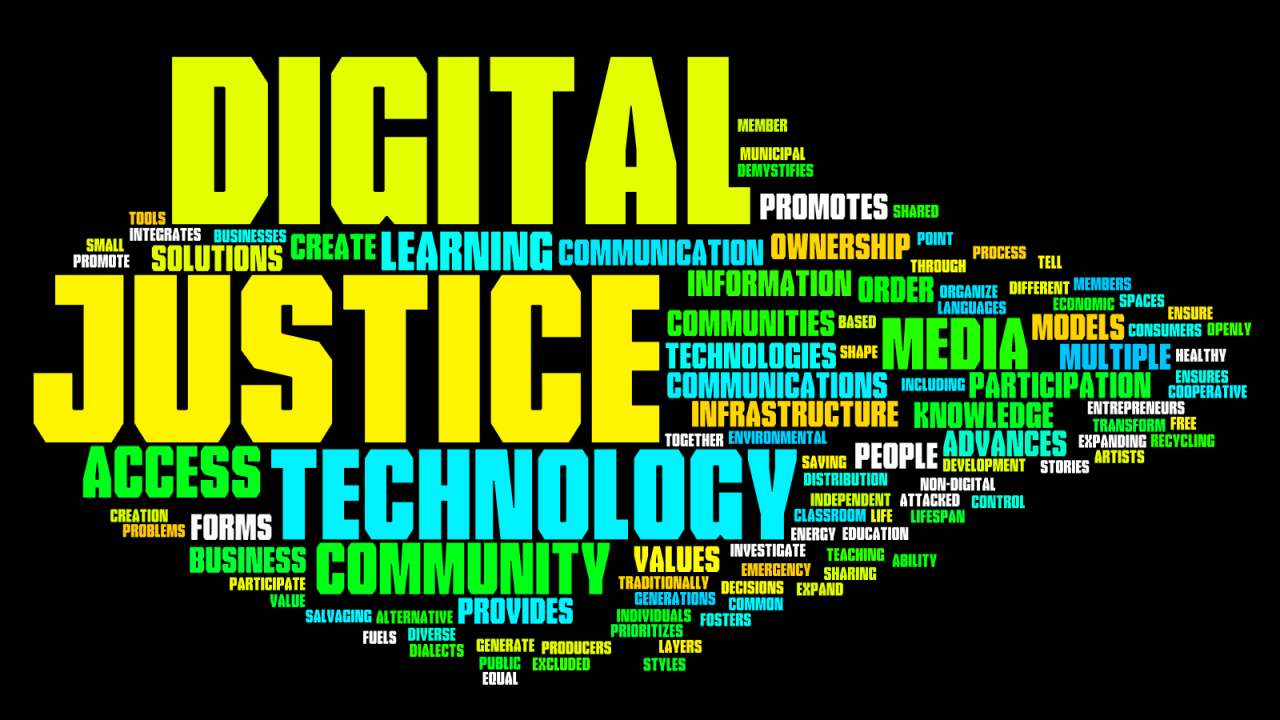
The Detroit Digital Justice Coalition is a very important part of Allied Media Projects. As a little experiment to understand their values, I created a word cloud representing the principles of the Detroit Digital Justice Coalition. Using only the “Principles” page on their blog site, the size of the word corresponds to how many times it has been used. It’s a bit abstract, but creates a great visual representation of their vocabulary.
To read more about DDJC’s principles, click here.
Allied Media Projects Diagram
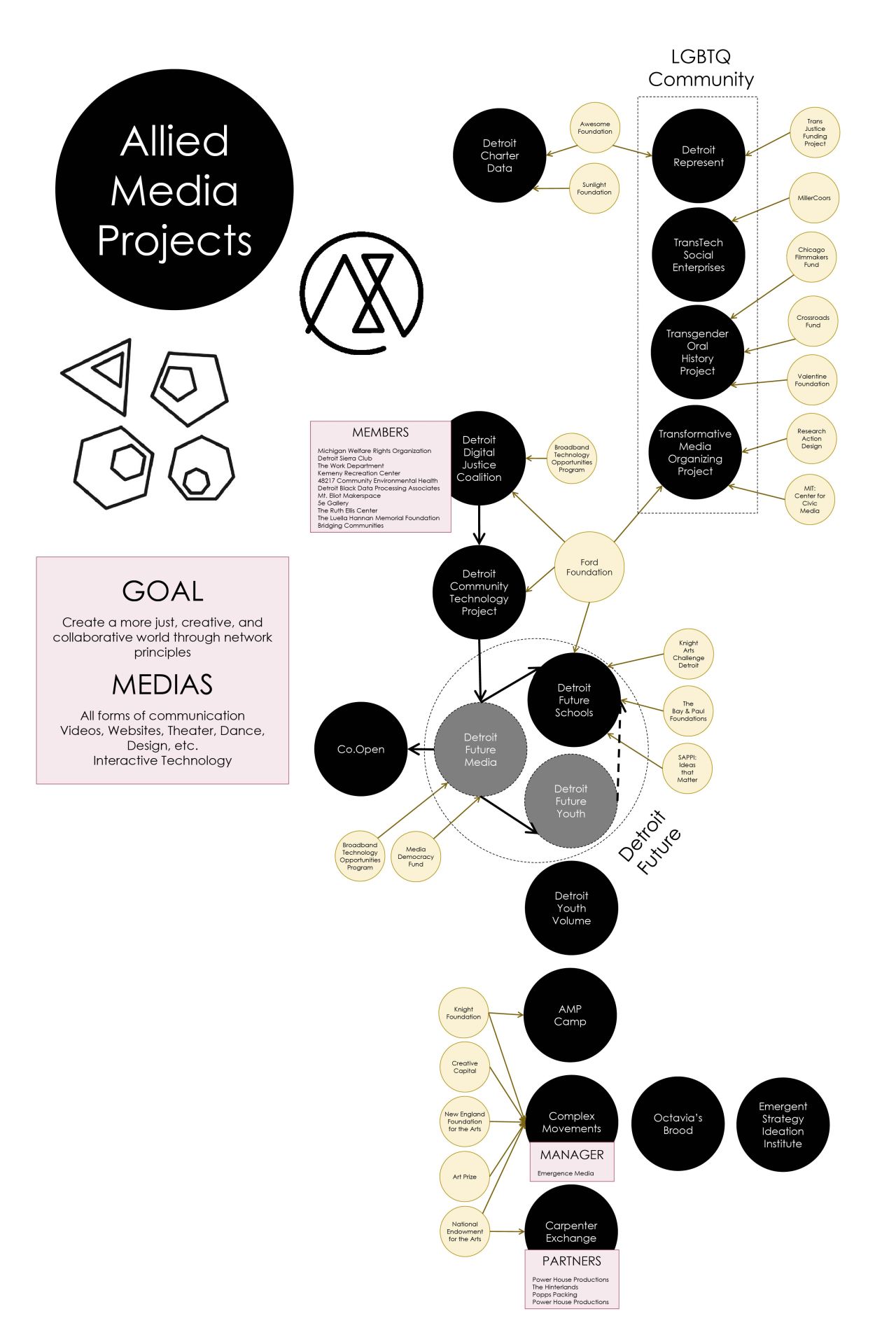
The organization I will be studying and working with throughout the semester is Allied Media Projects in Detroit. To better understand who they are, I examined all of their sponsored projects and constructed a diagram showing how they connect to each other through project initiatives and funding sources. This diagram is just a draft based on what I’ve read so far on their website, but there is still much to discover about them.
For more information about Allied Media Projects, click here.
Design Advocacy
In architecture, advocacy is a way of communicating ideals by applying them through a body of work. The founder and CEO of Architecture 2030, Edward Mazria, demonstrated this throughout his personal architecture career and into Architecture 2030.
Edward Mazria advocates sustainability, reducing energy consumption and greenhouse gas emissions, and the use of new technologies and innovations in the process of reaching global environmental goals. Many of his buildings in New Mexico, including the Bosque School in Albuquerque and Genoveva Chavez Community Center in Santa Fe, use passive solar heating and water harvesting strategies, which communicate his strategy towards design advocacy.
Mazria became so involved in his values towards a better future, that he closed his architecture practice to dedicate all of his attention towards the Architecture 2030 project.
Before Architecture 2030, his body of work also spoke measures towards sustainability. Genoveva Chavez Community Centerctice to focus on transforming the Building Sector (which is responsible for almost half of all fossil fuel consumption and greenhouse gas emissions) from being a part of the problem to a solution to the crisis, thus founding the Architecture 2030 Challenge.
Design Advocacy takes more than just good intentions, but action and sometimes, radical decisions. Mazria’s ideals were incorporated into legislation when Congress passed the Energy Independence and Security Act of 2007.
Read more:
Edward Mazria: http://www.mazria.com/profile.html
Architecture 2030: http://architecture2030.org/about/

OmniCorpDetroit Visit
5-18-2015
OmniCorp is a makerspace, a space for artists to…well, make things, using the resources provided within the space and collaborate with each other. When the class visited OmniCorp in Detroit, Paul (a student from last semester’s ID5 class) showed us around.
The space itself is rather interesting. OmniCorp doesn’t have a formal organization, and the layout reflects that. Different projects litter the floors, walls, and even ceilings. There are no hallways, so it’s just one room flowing into the next, each space getting smaller. Paul explained that the first room, the largest, is where the tables and projects move around often, depending on the needs of the space. The smaller rooms are for extended projects. There are no formal rules, so if somebody wants to use one of the smaller rooms, he/she just casually asks the other members if they’re using it.
The building itself blends with the other projects, which I found very interesting and reflective of the group. The floorboards seem patched together like it was built over time, the walls are made of different materials, and even the elevator is used as a small shop.
The experience was eye-opening to me because I never thought any kind of operation could run with so little regulation. The concept is still foreign to me, however, being a creature of rules and strict organization, but it’s nice to know that I don’t have to be in order to create amazing art like the people at OmniCorp.
Check out their blog at: http://omnicorpdetroit.com/blog/
Introduction
Welcome to my new website! This is where I will be posting my progress in my current class: Integrated Design 5: Architect as a Spatial Agent, and where I will continue posting my work, thoughts, ideas, goals, and inspirations throughout my architectural career, so this website will grow as I grow.
I’ve been studying architecture for the past 5 years now, and I’m finally getting a sense of where I want to go with it. Combining my passion for architectural design and my interest in science and global crises, I want to become a humanitarian architect. Some of the biggest humanitarian challenges we face come from our environment; from declining resources to pollution. If we want to maintain life on this planet for many more generations to come, some major changes need to be made in this generation.
While many organizations continue to raise awareness of environmental issues and what we, the everyday people can do to help prevent a global crisis, that can only go so far. Not everybody is willing to play their part recycling, turning off the lights, etc. That’s why I will be focusing on the roles that science and technology play in the designed environment. If we can’t get everybody to turn off their lights when they’re not using them, then why not build a more efficient bulb? That’s exactly what three Japanese and American scientists did when they produced the first blue LED in 1992, the same year I was born, allowing the production of white LEDs, which are now the most efficient mass market lighting used all around the globe today.
http://www.nobelprize.org/nobel_prizes/physics/laureates/2014/popular-physicsprize2014.pdf
In the architectural discipline, there are many, many areas for improvement, from heating and cooling to material production and transportation. With so many opportunities, I look forward to working towards the next big solution. Let’s change the system!
 Desk of Eric Soller