Operation H.A.U.N.T.

HAUNT

Projectors display prospective futures of Detroit’s abandoned buildings

After a great amount of brainstorming, the nature of my project has changed to have a more specific focus. This is Operation H.A.U.N.T.:

Hosting
Apparitions for the
Urban
Need of
Transformation

The goal is to virtually occupy abandoned buildings within Detroit by projecting a modern schoolhouse environment with teachers, students, etc. over their broken facades. When one of the biggest attractions of Detroit is its abandoned buildings, this provides an opportunity for movement. People come in from all around the country to gaze into the Detroit’s thriving history, but Operation H.A.U.N.T. is going to change perspectives. Instead of gazing into the past, viewers will see a potential future for these ruins. Instead of focusing on the decline of Detroit, Operation H.A.U.N.T. will provide the community with a sense of hope and opportunity for the future of Detroit.
Midterm Review

Last Monday (June 15), our class had a midterm review to discuss our research and start the process in developing a tangible project. The critics wanted me to focus on the role of technology in Allied Media Projects; exploring the social implementations of technology as well as the spatial impacts of the work they produce. The Allied Media Conference 2015 was taking place the following weekend, so I needed to find connections between my own agenda and the goals of Allied Media.

The following workshop, which took place on Wednesday (June 17), the critics came back to work with the class individually. Mike Hopkins worked with me to discuss my goals as an architect, which are more environmental than social, and where my focus should be to connect with an organization who is all about social movements within Detroit. Most of the ideas were sketchy and vague, but we made a lot of progress brainstorming ideas from mapping out CO2 emissions within Detroit to raise awareness within the community to creating a digital rendering of the city projected on a screen acting as a window to Detroit’s future, showing what it might look like in the future.

On Saturday, I attended the Allied Media Conference. I only stayed for a short period of time, but I was able to speak with the program manager of the conference and network with a few other people. The session I stayed for was called Speculative Cities: Becoming Place. The presentation was about the role of gentrification throughout Detroit’s history and the need for communities to break out of isolation and connect with each other, helping to re-define the city of Detroit. The presentation helped me understand the importance of social connection, and I started to readjust my thinking towards my project.

Now, I am in the process of developing a way for people from different neighborhoods within Detroit to find each other, through technology. I recalled reading about a project, which has now become a significant case study in my research, where doors were installed in random places on the street in Europe, and people would open them to see a mime performance in Milan or have their portraits painted by a sketch artist in Brussels. It was all done with big screens and cameras. The concept was to get people to visit different areas of Europe because they’re “just next door.” This project has become a huge inspiration in my own project to connect different neighborhoods within Detroit.

Here’s a link to an article and video about the European project.

Word Cloud

Detroit Digital Justice Coalition

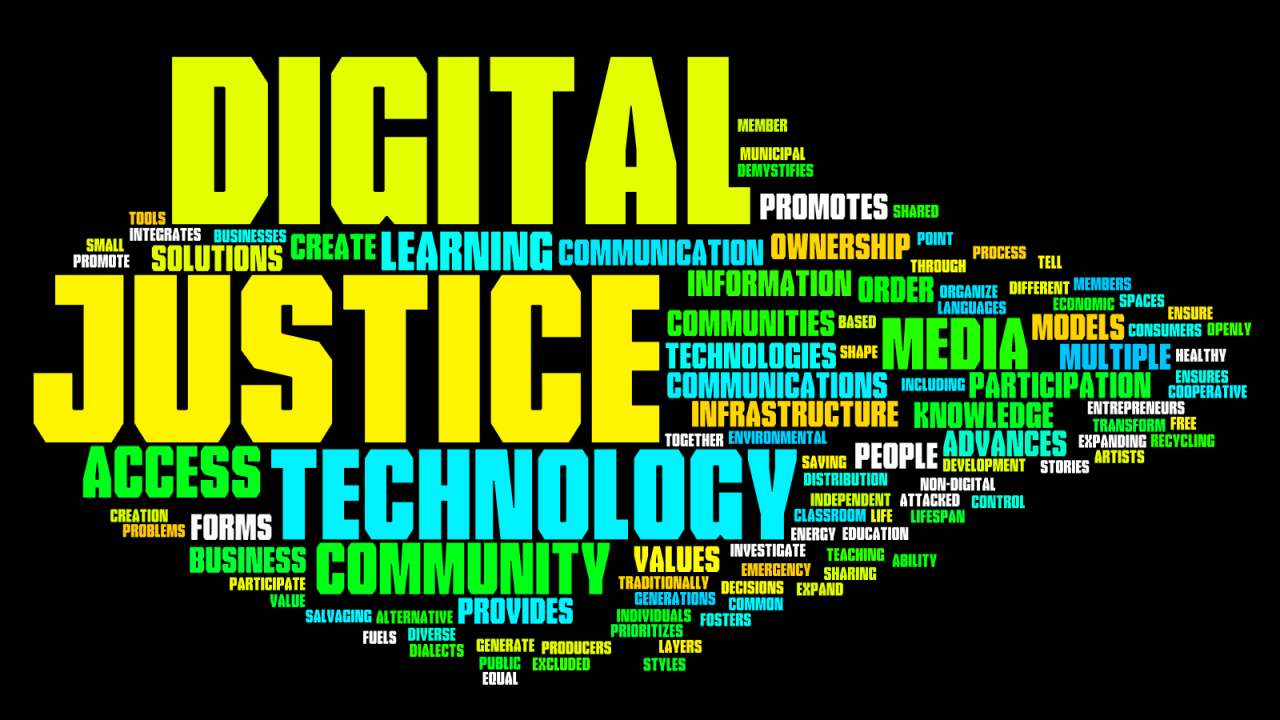
The Detroit Digital Justice Coalition is a very important part of Allied Media Projects. As a little experiment to understand their values, I created a word cloud representing the principles of the Detroit Digital Justice Coalition. Using only the “Principles” page on their blog site, the size of the word corresponds to how many times it has been used. It’s a bit abstract, but creates a great visual representation of their vocabulary.

To read more about DDJC’s principles, click here.

OmniCorpDetroit Visit

5-18-2015

OmniCorp is a makerspace, a space for artists to…well, make things, using the resources provided within the space and collaborate with each other. When the class visited OmniCorp in Detroit, Paul (a student from last semester’s ID5 class) showed us around.

The space itself is rather interesting. OmniCorp doesn’t have a formal organization, and the layout reflects that. Different projects litter the floors, walls, and even ceilings. There are no hallways, so it’s just one room flowing into the next, each space getting smaller. Paul explained that the first room, the largest, is where the tables and projects move around often, depending on the needs of the space. The smaller rooms are for extended projects. There are no formal rules, so if somebody wants to use one of the smaller rooms, he/she just casually asks the other members if they’re using it.

The building itself blends with the other projects, which I found very interesting and reflective of the group. The floorboards seem patched together like it was built over time, the walls are made of different materials, and even the elevator is used as a small shop.

The experience was eye-opening to me because I never thought any kind of operation could run with so little regulation. The concept is still foreign to me, however, being a creature of rules and strict organization, but it’s nice to know that I don’t have to be in order to create amazing art like the people at OmniCorp.

Check out their blog at: http://omnicorpdetroit.com/blog/